
How to Become a Successful Entrepreneur in Saudi Arabia
Saudi Arabia moved from 83rd to 23rd in global entrepreneurial environment rankings between 2021 and 2025. That shift did not happen by accident. It happened because the structural conditions for building a business in the Kingdom changed in ways that are real, measurable, and still accelerating.
The number of active SMEs grew from 429,000 when Vision 2030 launched to over 1.7 million by the end of 2025. Venture capital investment grew 25-fold between 2018 and 2025. The Kafalah program issued SAR 93 billion in guarantees last year alone, enabling over 27,000 enterprises to access financing. Saudi Arabia attracted $1.72 billion in VC funding in 2025, leading the MENA region.
The market is moving. The question is whether you are positioned to move with it.
Understand What the Market Actually Rewards Right Now
Every entrepreneur in Saudi Arabia is operating inside the same macro environment, but not everyone reads it the same way. Vision 2030 is not just a government program. It is a restructuring of the economy, and the sectors it is restructuring are specific.
Tourism, entertainment, sports, technology, fintech, e-commerce, logistics, and manufacturing are receiving deliberate capital and regulatory support. Non-oil exports reached SAR 622 billion in 2025. The digital economy is expanding at a pace that makes sector-specific platforms viable in ways they were not five years ago.
The entrepreneurs who succeed here are not the ones who build what they want to build. They are the ones who identify where government policy, capital flows, and demographic demand are converging, and build at that intersection.
Saudi Arabia has a population of over 36 million, one of the highest smartphone penetration rates in the world at 96 percent, and a median age under 30. Any business that does not start with a deep understanding of who the Saudi consumer is and what they are doing online is starting from the wrong place.
Build Your Legal Foundation Before You Need It
Registration is faster than it has ever been in Saudi Arabia. A commercial registration through Monsha'at can be completed in hours. But registration is not the same as a sound legal foundation.
Structure matters from day one. The choice between a limited liability company and a joint stock company, the shareholding arrangements, and the IP ownership structure all become expensive problems if they are not addressed correctly at the beginning. Foreign entrepreneurs establishing operations in the Kingdom should note that 100 percent foreign ownership is now permitted in sectors including IT, healthcare, and real estate, but sector-specific restrictions still apply in others.
Work with legal counsel who understands both the letter of Saudi commercial law and the practical reality of how businesses operate here. The framework has improved dramatically. That does not make it simple.
Capital Is Available. Accessing It Requires Preparation.
The financing environment in Saudi Arabia is the best it has been in the Kingdom's modern history. The SME bank lending portfolio grew to SAR 148 billion. The Kafalah program makes bank lending commercially viable for enterprises that would otherwise struggle to access it. Equity markets have opened through Nomu, the parallel market, where 34 companies listed in 2025 with a combined market value of $450 million.
But capital does not flow to unprepared founders. Banks lend to businesses with clean financial records, coherent business plans, and credible projections. Investors invest in founders who understand their unit economics, their market size, and their path to defensibility.
The Tomouh program, which has directed over $15.7 billion into startups and SMEs since 2017, requires exactly this kind of preparation. So does every serious investor conversation you will have in Riyadh.
Build your financial discipline before you need the capital. Accurate books, clear records, and an ability to explain your numbers are not optional courtesies for Saudi entrepreneurs. They are the ticket to the room where the funding decisions happen.
Saudization Is a Strategic Lever, Not Just a Compliance Requirement
Nitaqat, the Saudization framework, is one of the most consistently misunderstood elements of operating a business in the Kingdom. Many founders treat it as a compliance burden. The ones who succeed treat it as a talent strategy.
Saudi Arabia's female labor participation rate reached 35 percent in 2025, surpassing the Vision 2030 target of 30 percent and continuing to rise. Women now own 45 percent of active commercial registrations in the Kingdom. The talent pool of qualified, ambitious Saudi nationals is larger than it has been at any point in the country's history.
The entrepreneurs who thrive here are the ones who figure out how to attract, develop, and retain that talent. Not because Nitaqat requires it, but because it is the right strategic move in a market where relationships with Saudi talent, Saudi customers, and Saudi institutions all compound over time.
Learn From People Who Have Already Done It
The fastest way to compress the learning curve of building a business in Saudi Arabia is direct access to people who have already navigated it. Not content about it. Not courses on it. Actual peer-to-peer conversation with entrepreneurs who have built, scaled, and in some cases sold businesses here.
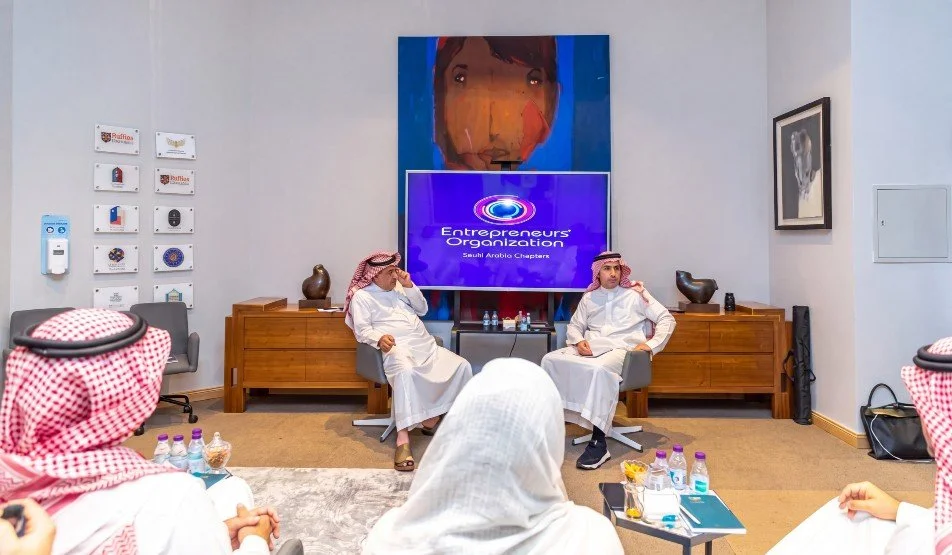
This is the core value proposition of the EO model. Forum groups of six to eight founders meeting monthly to share real business problems without filters or promotion. Guest speakers who are among the most accomplished operators in the Kingdom. A global network of 18,444 members across 61 countries that becomes immediately relevant when you are thinking about expansion, capital, or partnership.
EO Riyadh members include founders across sectors, from energy advisory to consumer brands to professional services. The knowledge that circulates in those rooms is not available anywhere else, because it is not the kind of knowledge that gets published. It is the operational reality of running a business in Saudi Arabia, shared openly because the forum environment creates the conditions for honesty.
Think Regional from the Start
One of the structural advantages of building in Riyadh specifically is that Saudi Arabia functions as the gateway to a $1.5 trillion regional economy. The GCC market is increasingly integrated. Entrepreneurs who build with a regional mindset from the beginning create distribution leverage that entrepreneurs who stay domestic rarely develop.
This means understanding how your business model translates across the UAE, Kuwait, Bahrain, Qatar, and Oman. It means building relationships with operators in those markets early. And it means structuring your legal and operational foundation in a way that does not create barriers when you want to expand.
EO's global chapter network makes this meaningfully easier. A direct connection to a fellow EO member in Dubai or Abu Dhabi is a different conversation from a cold introduction. It carries trust, shared context, and a framework for honest exchange that shortens the timeline from curiosity to collaboration.
Resilience Is Not a Soft Skill
Every business hits problems. The ones in Saudi Arabia are specific to this market. Regulatory changes, supplier reliability, the pace of Saudization compliance, cash flow pressure during Ramadan, the seasonal compression of Q3 during summer heat, and the cultural dynamics of client relationships in the Kingdom all require a specific kind of operating resilience.
The five-year startup survival rate in Saudi Arabia improved from 30 percent to 42 percent between the start of Vision 2030 and 2025. That improvement is real. It is also still a failure rate of 58 percent within five years. Building a successful business here requires more than a good idea and adequate capital. It requires the ability to adapt, to solve problems without a clear template, and to keep moving when the path forward is not obvious.
The entrepreneurs who consistently demonstrate this in the EO Riyadh community are not the ones who have avoided hard periods. They are the ones who walked through them with a peer group that gave them honest counsel, held them accountable, and celebrated the wins when they came.
The Window Is Open
Saudi Arabia's entrepreneurial environment has never been more receptive to serious founders. The regulatory infrastructure has improved. The capital is available. The demographic conditions are exceptional. The giga-projects, the tourism expansion, the digital economy build-out, and the ongoing privatization pipeline are all creating new markets that did not exist a decade ago.
The founders who capture that opportunity will not be the ones who waited for perfect conditions. They will be the ones who built relationships, developed financial discipline, hired the right people, and stayed close to others who were doing the same thing.
If you are building a business in Saudi Arabia and you are not yet part of a peer network that holds you to a higher standard, that is the most direct improvement you can make to your trajectory today.
EO Riyadh connects ambitious business owners across Riyadh's entrepreneurial landscape. Learn more and apply at eoriyadh.org.
FAQ
-
A commercial registration through Monsha'at is the starting point, which can now be completed within hours. Depending on the business structure and sector, additional licenses, a minimum capital requirement, and Saudization compliance under the Nitaqat framework may apply. Foreign entrepreneurs can now own 100 percent of businesses in several key sectors including IT and healthcare, though sector-specific restrictions remain in others.
-
Technology, fintech, e-commerce, tourism, entertainment, logistics, and professional services are the sectors receiving the most deliberate policy support and capital under Vision 2030. Saudi Arabia attracted $1.72 billion in venture capital in 2025, led by fintech, software, e-commerce, and artificial intelligence. Founders who build at the intersection of Vision 2030 priorities and genuine consumer demand are the most positioned to grow.
-
The Kafalah loan guarantee program, administered through Monsha'at, reduces commercial risk for bank lending to SMEs. The SME Bank provides direct financing and debt-based crowdfunding. Venture capital through Sanabil, STV, and the Jada Fund of Funds is available for high-growth startups. Nomu, the parallel equity market, provides a listing pathway for growing companies. All of these channels require clean financial records and a credible business plan.
-
EO Riyadh is the Saudi chapter of the Entrepreneurs' Organization, a global peer network of 18,444 members across 61 countries. The Riyadh chapter connects business owners through monthly forum groups, curated events, and access to the global EO network. Membership is for entrepreneurs who have crossed meaningful revenue thresholds and are committed to peer-to-peer learning rather than networking for its own sake.

