
Common Challenges Entrepreneurs Face in Saudi Arabia
58 percent of Saudi businesses do not survive their first five years. The five-year survival rate improved from 30 percent to 42 percent between Vision 2030's launch and 2025, which is meaningful progress. But the number that remains is still a majority failure rate, and it is concentrated in predictable, avoidable patterns.
The founders who make it through are not always the ones with the best ideas or the most capital. They are the ones who anticipated the specific friction points of building a business in the Kingdom and prepared for them before they hit. The ones who did not tend to treat the challenges as surprises, which makes them more damaging than they needed to be.
This is what those challenges actually look like.
Accessing Capital Beyond the First Round
The financing environment in Saudi Arabia has improved substantially. The SME financing portfolio has grown to nearly SAR 148 billion, and venture capital investment reached $1.72 billion in 2025, leading the MENA region. For founders who know how to navigate the system, early-stage capital is more accessible than it has ever been. Qoyod
The problem surfaces at the next stage. Growing a 10-person business into a 100-person business requires a different kind of capital, a different risk profile, and a different relationship with lenders and investors. Commercial banks were historically oriented toward corporate lending and offered few products tailored to small business needs. That orientation has shifted, but not uniformly. Founders who secured seed or early growth financing frequently find that the bridge to the next stage requires financial records, revenue consistency, and borrower credibility that takes years to build. Vision2030
The practical implication: the entrepreneurs who access capital most effectively in Saudi Arabia are not the ones who apply for it when they need it. They are the ones who spent the preceding 18 months building their financial infrastructure, keeping clean books, and developing relationships with the institutions that make the decisions.
Navigating Regulatory Complexity Across Multiple Authorities
Registering a business in Saudi Arabia can now be done quickly through unified digital platforms. Users may submit articles of association and apply for a business name within minutes, though final approval from the Ministry can take a week or longer, and applicants must complete several additional steps including obtaining municipality licenses, and registering with the Ministry of Human Resources, Chamber of Commerce, Passport Office, Tax Department, and General Organization for Social Insurance. U.S. Department of State
That is five separate registrations beyond the initial application. For most founders, the administrative load does not end at setup. Regulatory complexity across multiple licensing authorities creates ongoing administrative overhead that disproportionately affects smaller businesses. Large corporations have legal and compliance teams. Founders carry it themselves, or pay for advisors, which compresses already thin margins in the early years. Vision2030
The regulatory environment is also not static. Vision 2030 has produced a pace of reform that is genuinely impressive and simultaneously difficult to track. Rules that applied when a business was registered may have changed by the time it is scaling. Over 40 percent of fintech startups reported difficulties in navigating the regulatory landscape. The number is specific to fintech, but the pattern generalizes across sectors. Research And Markets
Hiring and Retaining the Right People
Talent is one of the most consistently cited operational challenges for Saudi founders, and it operates on two levels that interact in complicated ways.
The first is Saudization compliance under the Nitaqat framework. Companies report increasing difficulties obtaining visas for expatriate professional employees, and firms may face challenges in finding enough qualified Saudi nationals to fill roles. In some cases, public procurement regulations require companies to Saudize project teams as a condition of contract award or continuation, even in technical areas where qualified Saudi professionals are scarce. International Trade Administration
The second is the skills gap that exists independently of Nitaqat. 40 percent of Saudi business leaders cited skills gaps as a major concern in PwC's 28th CEO Survey, particularly in technical and engineering fields where expatriate workers have historically dominated. The pool of qualified Saudi nationals is growing and is larger than at any point in the Kingdom's history. It is also still being built. NES Fircroft
These two realities create a specific operational challenge: compliance requirements that run ahead of talent supply in certain specialized functions. The founders who navigate this most effectively treat Saudization not as a quota problem but as a talent development mandate. They invest in Saudi national employees earlier, develop them more deliberately, and build internal pipelines instead of trying to hire ready-made capability that the market does not yet have in sufficient depth.
Cash Flow Pressure from Extended Payment Cycles
Saudi Arabia's business environment has a structural characteristic that affects almost every B2B founder at some point: whether dealing with large local corporations or government entities, long payment cycles are often the norm. Late payment from large corporate and government clients affecting SME cash flow is one of the documented structural weaknesses in the Kingdom's entrepreneurial ecosystem. QashioVision2030
The pattern is predictable. A contract is won. Work is delivered. The invoice goes into a corporate or government payment queue that runs on 60, 90, or 120-day cycles. Meanwhile, payroll, rent, supplier invoices, and Saudization contributions run on a monthly cycle that does not pause for a slow-paying client.
Most SMEs have no defined minimum cash buffer. They operate right up to the edge, leaving zero margin for a delayed payment, a surprise cost, or a slow quarter. Synergy Strat
The resolution is not exciting: it is financial discipline established before the pressure arrives. A rolling 13-week cash flow forecast alongside a P&L, a defined minimum cash reserve of 8 to 12 weeks of fixed costs, and explicit payment terms negotiated into contracts from the start. Founders who skip this infrastructure tend to discover they need it at exactly the wrong moment.
Scaling Beyond Riyadh
Market concentration in Riyadh and Jeddah means there is a limited SME ecosystem in secondary cities. For founders who build their initial model around the capital's infrastructure, customer density, and investor network, expanding to Makkah, Dammam, Madinah, or Tabuk introduces operational complexity that the Riyadh experience does not fully prepare them for. Vision2030
Consumer behavior, logistics infrastructure, local relationship dynamics, and the pace of business all vary across the Kingdom in ways that are real but easy to underestimate from inside Riyadh. Founders who treat expansion as a copy-paste of their Riyadh model tend to hit friction. The ones who treat each market as requiring its own customer research, local relationships, and sometimes a different operating model do better.
The same challenge applies to GCC expansion. 36 percent of entrepreneurs cite Riyadh's connectivity to MENA markets as a primary reason for locating here. The access is real. So is the operational complexity of running a business across multiple regulatory environments, currencies, and cultural contexts simultaneously.
Building a Business in a Market Changing Faster Than Your Plan
Saudi Arabia's entrepreneurial environment is moving at a pace that creates a specific strategic problem. The regulatory changes, new government programs, shifts in consumer behavior, and competitive entries that restructure markets are all happening faster than a standard three-year business plan can accommodate.
Founders who wrote detailed plans in 2022 found that significant parts of their market assumptions had shifted by 2024. Vision 2030 execution has accelerated across every sector simultaneously, which creates opportunity and disruption at the same time. New giga-projects open procurement pipelines. New entrants arrive with international capital and technology. Consumer expectations shift as the quality of available products and services rises across the board.
The founders who handle this best are not the ones with the most sophisticated forecasts. They are the ones with the strongest peer networks, real-time information from people operating inside the same market, and the judgment to adapt quickly when conditions change. That judgment is not something that can be developed in isolation. It comes from sustained, honest exchange with people who are navigating the same environment and are willing to share what is actually happening, not what looks good to say publicly.
The Isolation Problem
There is a challenge that does not appear in government reports or ecosystem assessments because it is not quantifiable: the weight of carrying a business without people who genuinely understand what that means.
Saudi Arabia's entrepreneurial culture is evolving rapidly, and the social acceptance of risk-taking and business failure has improved considerably under Vision 2030. But the operational reality of running a growing company, making decisions that affect employees and their families, managing investor expectations, and sustaining forward momentum through difficult quarters is still a largely solitary experience for many founders.
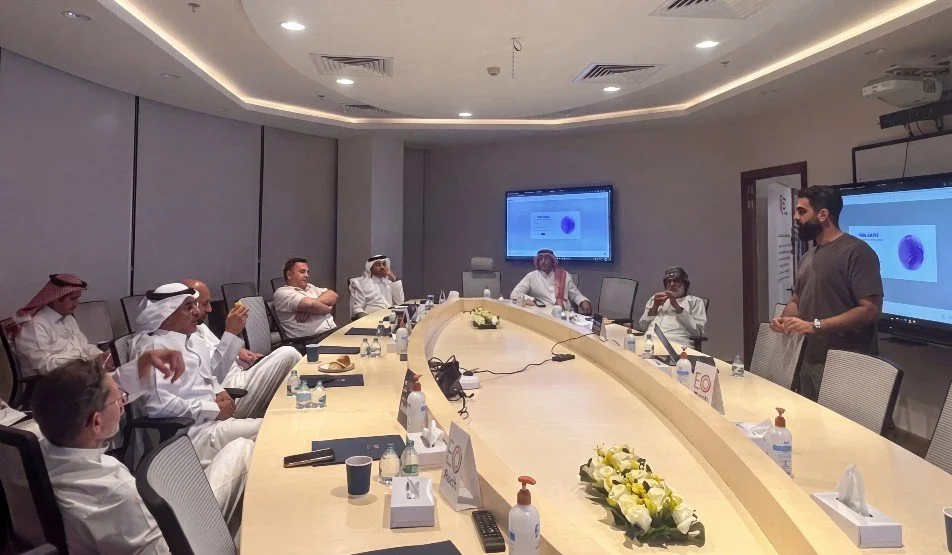
This is the gap that a serious peer community fills. Not coaching or mentoring in the traditional sense, but a trusted circle of people who are in the same situation, bound by confidentiality, and committed to honest exchange rather than performative success. The founders who access this kind of peer learning consistently report it as the highest-value input to their business decisions. Not because the group gives them answers, but because the honest reflection of peers who have walked through similar challenges produces better thinking than any individual can generate alone.
EO Riyadh connects business owners across the Kingdom's entrepreneurial ecosystem through peer-to-peer learning, curated events, and access to a global network of 18,444 entrepreneurs in 61 countries. Apply at eoriyadh.org.
FAQ
-
The five-year survival rate improved from 30 percent to 42 percent between Vision 2030's launch and 2025, but the majority of businesses still do not make it past five years. The most consistent causes are cash flow problems from extended payment cycles, regulatory compliance overhead that early-stage teams are not equipped to manage, and the transition from startup operations to structured management as the business scales. Founders who address these systematically rather than reactively tend to survive longer.
-
The most effective approach treats Nitaqat not as a compliance exercise but as a talent strategy. This means identifying Saudi national candidates earlier in the hiring cycle, investing in training and development rather than expecting ready-made expertise, and building internal pipelines in the specific functions where qualified Saudi talent is harder to find. Companies that invest in developing Saudi employees over time build a structural competitive advantage in both compliance and retention.
-
It has improved substantially since Vision 2030's launch. Business registration is faster. Digital platforms have reduced administrative friction. But regulatory complexity across multiple licensing authorities still creates overhead for smaller businesses, and the pace of reform means that rules change frequently enough to require active tracking. Working with local legal counsel who understands both the formal framework and the practical operating reality is worth the cost, especially in the first two years.
-
The challenges Saudi entrepreneurs face most commonly are not solved by information alone. Cash flow discipline, talent decisions, regulatory navigation, and scaling strategy all improve with access to people who have encountered the same problems in the same market and are willing to share what happened. EO Riyadh provides that access through confidential monthly forum groups of non-competing founders, where the real questions can be asked and the real answers are shared.

